PrintableCharts

SUMS OF FIBONACCI NUMBERS

how to write any positive whole number as a sum of Fibonacci numbers, no two of them neighbours

Built as a memo rather than a table: the thing worth hanging it up for reads across the room, with the full reference in smaller type below it.

Three sizes in one archive — from a sheet on the fridge to a poster on the wall.

Free

By downloading you agree to the Terms.

Formats
A4 · A3 · A2
What you get
Print-ready PDFs, one per size, with every letterform converted to outlines — nothing to install, nothing to shift.
Subject
maths · school · memo · classroom

Fibonacci numbers here: 1, 2, 3, 5, 8, 13… — a single 1, and from 3 on each is the sum of the two before it. The code 1000010100 reads 89 + 8 + 3.

ZECKENDORF’S THEOREM

Edouard Zeckendorf, a Belgian army doctor and amateur mathematician, proved that every positive whole number has only one sum of distinct, non-neighbouring Fibonacci numbers. He found it in 1939 but published it only in 1972, twenty years after the Dutch mathematician Gerrit Lekkerkerker had.

On the sheet

  • Fibonacci numbers here: 1, 2, 3, 5, 8, 13… — a single 1, and from 3 on each is the sum of the two before it. The code 1000010100 reads 89 + 8 + 3.
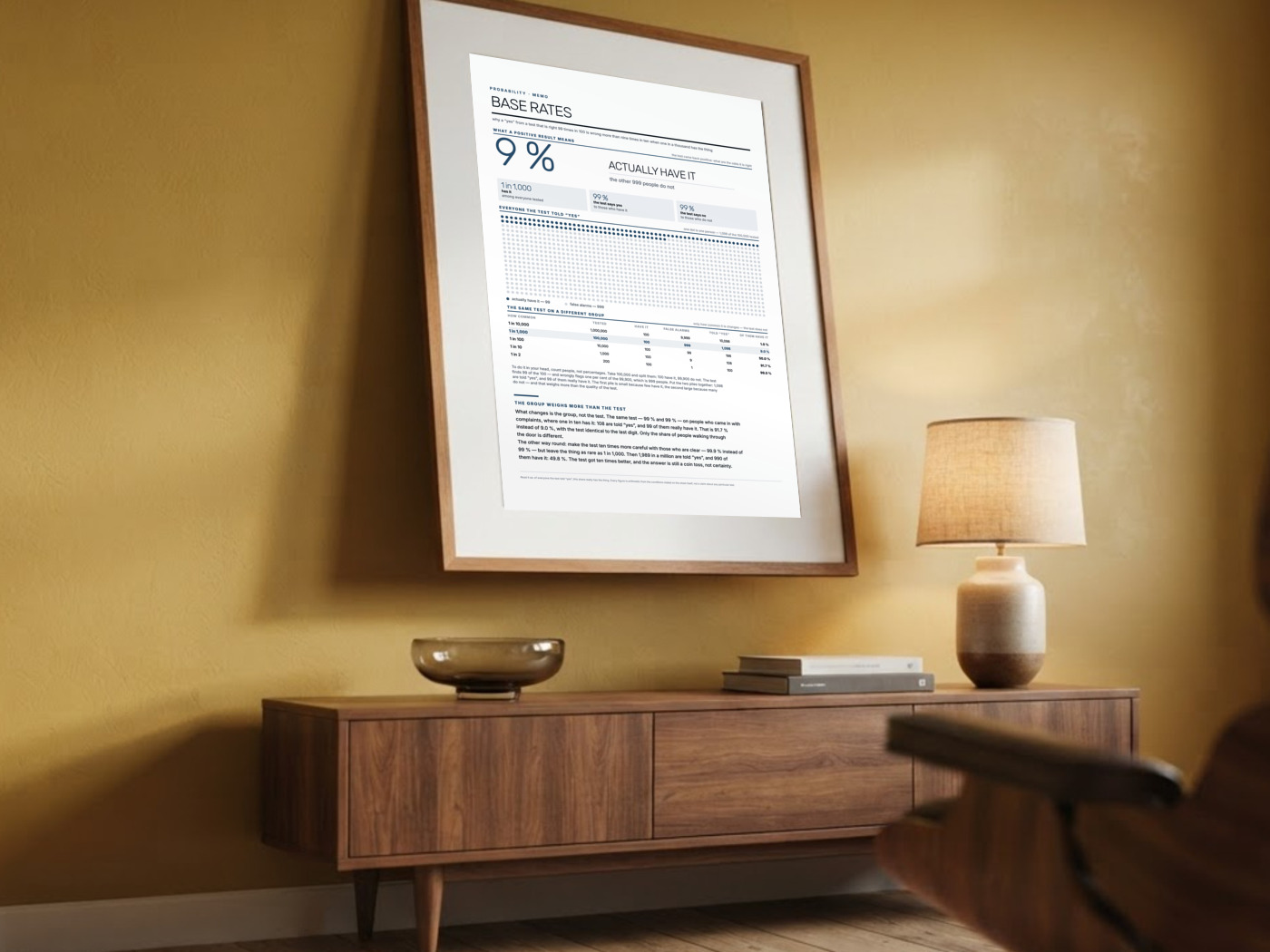
  • Colour carries meaning, but meaning never rests on colour alone — the sheet reads in black and white.
  • Nothing about how it was made: the sheet carries only what the reader needs.

Printing

  • Three sizes in the archive: A4 — 210×297 mm, A3 — 297×420 mm, A2 — 420×594 mm.
  • All text is converted to outlines. No fonts to install, and nothing shifts on another machine.
  • White background and sparing fills — it prints on a home printer without draining the cartridge.
  • Margins of at least 10 mm: a home printer cannot print to the edge.
  • No stroke thinner than 0.3 mm, so nothing disappears in print.

Why the numbers can be trusted. Every countable number here is computed from data rather than typed in, and the sheet must pass 3 independent checks before it is allowed to build — how many items there are, the order they come in, and the claim in the highlighted box itself. If one fails, there is no file.

More like this

Free printable sums of fibonacci numbers chart (PDF) — Printable Charts